If you've searched for a non-surgical way to firm sagging skin, you've likely run into four names over and over: XERF, Thermage, Ultherapy, and Morpheus8. They're often mentioned in the same breath, but they are not the same treatment, and they don't work the same way. As a family physician and aesthetic practitioner in Edmonton, I get asked almost weekly which one someone "actually needs." This guide breaks down how each device works, what it's built to treat, and how a physician thinks through the decision , so you can have an informed conversation at your next consultation, wherever you choose to have it.
Whether you are noticing the early signs of laxity along your jawline or exploring options to refresh your overall facial contour without surgery, understanding the technology behind these treatments is the first step toward making the right choice for your skin health. For more on our comprehensive approach to facial rejuvenation, you can explore our guides on fine lines and wrinkles or schedule a personalized skin analysis at our Edmonton clinic.
What do XERF, Thermage, Ultherapy, and Morpheus8 have in common?
All four are non-surgical, energy-based devices designed to address loose or lax skin by heating tissue enough to trigger collagen remodelling, without cutting or removing skin the way a surgical facelift does. Beyond that shared goal, they differ in the type of energy they use, how deep that energy travels, and whether the skin's surface is punctured to get there.
Choosing the right device requires looking beneath the surface to understand what your unique skin structure needs. Let's examine each of these leading technologies in detail.
What is XERF and how does it work?
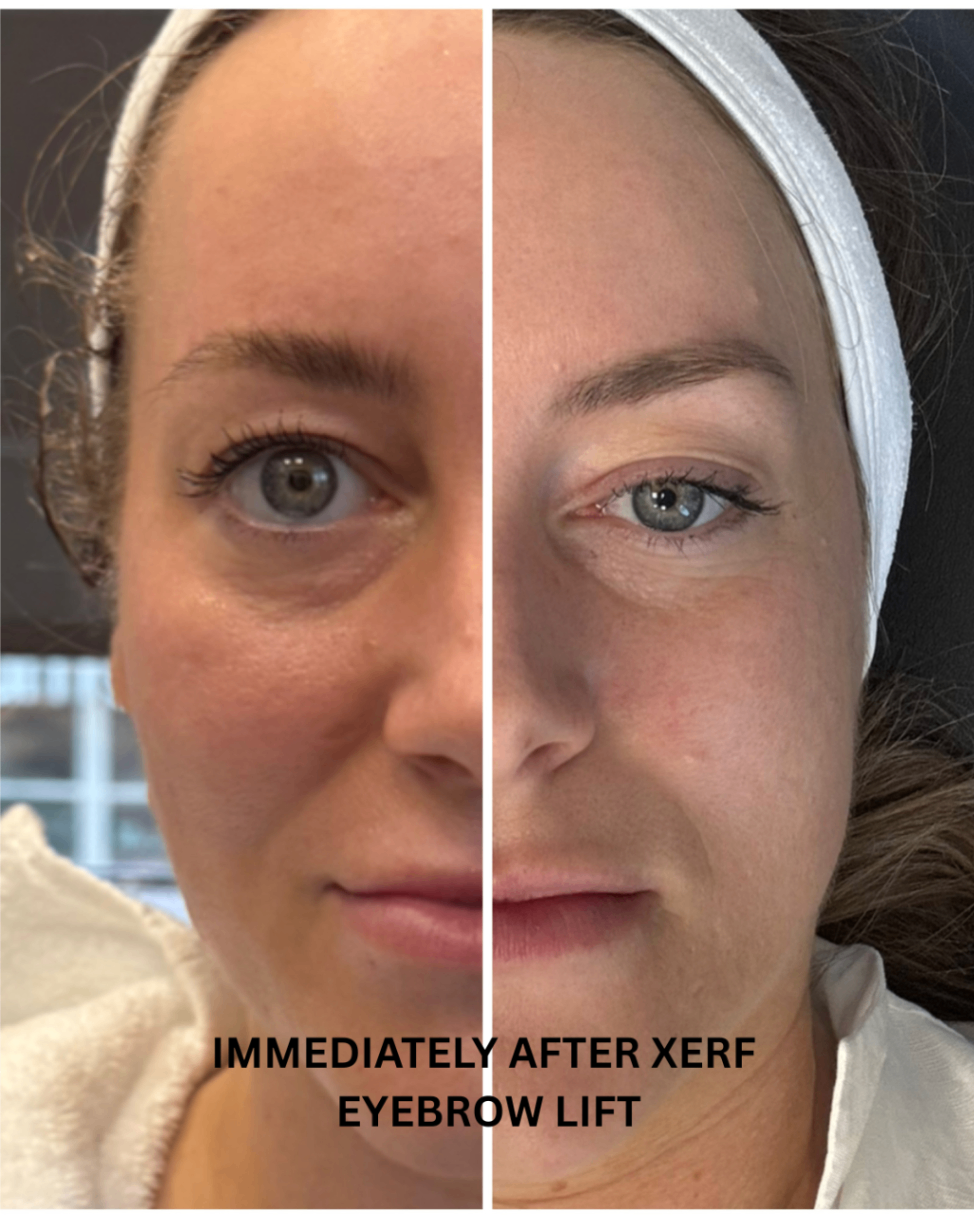
XERF is a dual-frequency monopolar radiofrequency (RF) device that delivers two frequencies , 6.78 MHz and 2 MHz , in the same session, without needles. The higher frequency is designed to act on the upper dermis, where fine surface texture lives, while the lower 2 MHz frequency is built to reach deeper, toward the SMAS (the superficial musculoaponeurotic system) , the same fibrous support layer surgeons work with in a facelift.
Built-in real-time impedance feedback adjusts energy delivery to the skin as it's being treated, and integrated cooling is designed to keep the surface comfortable throughout. Because there's no needle penetration, there's typically no numbing required and no visible downtime, which is part of why it's become a popular first step for patients who want a same-day, no-recovery appointment.
In fact, XERF has recently been popularized in celebrity circles, with high-profile figures like Kim Kardashian calling XERF her favorite go-to treatment for achieving that coveted, instantly "snatched" and contoured look without going under the knife.
What is Thermage and how does it work?

Thermage (currently in its FLX generation) is a single-frequency monopolar RF device, also delivered at 6.78 MHz, that has been used clinically since 2002. It heats the dermis and subcutaneous fibrous tissue through resistive (Joule) heating, using a capacitive-coupled tip that pairs RF delivery with cryogen cooling to protect the surface.
It's FDA-cleared for treating facial and body laxity, including areas like the eyelids that few other energy devices are cleared to treat. Thermage typically treats a single depth range per session (roughly 2–3 mm), and most protocols call for one treatment, with maintenance sessions considered every 12–24 months depending on how an individual's skin responds.
What is Ultherapy and how does it work?
Ultherapy uses micro-focused ultrasound with visualization (MFU-V) rather than radiofrequency. A built-in ultrasound image lets the provider see the tissue layers before treating, and the device then deposits focused ultrasound energy at specific, targeted depths , typically 1.5 mm, 3.0 mm, and 4.5 mm , creating small thermal coagulation points at each depth without affecting the skin between them. The 4.5 mm depth is designed to reach the SMAS layer.
Ultherapy is FDA-cleared to lift the eyebrow, tighten lax tissue under the chin and neck, and improve lines and wrinkles on the décolletage, with a newer PRIME version also cleared for the abdomen and arms.
What is Morpheus8 and how does it work?

Morpheus8 is a fractional RF microneedling device: fine needles physically penetrate the skin to deliver bipolar radiofrequency energy directly into the dermis and, at deeper settings, subdermal fat.
Depth is adjustable , commonly cited from about 0.5 mm up to 7–8 mm, depending on the tip used , which is why it's positioned for both facial skin tightening and body contouring. Because the needles create controlled micro-injury, there is more visible downtime than with XERF, Thermage, or Ultherapy , typically some redness, pinpoint bleeding, and swelling for a few days.
XERF vs Thermage vs Ultherapy vs Morpheus8: Side-by-Side Comparison
| Feature | XERF | Thermage FLX | Ultherapy | Morpheus8 |
|---|---|---|---|---|
| Energy type | Dual-frequency monopolar RF (6.78 MHz + 2 MHz) | Single-frequency monopolar RF (6.78 MHz) | Micro-focused ultrasound with visualization | Bipolar RF microneedling |
| Needles/downtime | No needles; no visible downtime | No needles; no visible downtime | No needles; no visible downtime | Needles; several days of redness/swelling |
| Depths addressed | Superficial, mid, and deep layers (including SMAS) in one session | Single treated depth range (~2–3 mm) | Set depths of 1.5, 3.0, and 4.5 mm (SMAS at 4.5 mm) | Adjustable, roughly 0.5–8 mm depending on tip |
| Real-time feedback | Impedance feedback adjusts energy during treatment | Impedance feedback (AccuREP) | Ultrasound depth/energy visualization before/during treatment | Set by tip and protocol, not real-time imaging |
| Typical protocol | Usually one session, individualized | Usually one session, individualized | Usually one session, individualized | Often a series of sessions |
| Best suited for | Patients wanting deeper structural tightening without downtime | Mild-to-moderate facial or body laxity, single-depth heating | Brow, submental/neck laxity, décolletage lines | Skin texture, scarring, and combined tightening with fat remodelling |
Individual results vary, and the right fit depends on your skin, your goals, and a physician's assessment , this table is an educational starting point, not a treatment recommendation.
How do I choose between these four treatments?
The honest answer is that it depends on three things: how much downtime you're willing to accept, how deep your skin laxity actually sits, and whether texture or scarring is part of what you're trying to improve.
- If you want zero downtime and are curious about deeper, structural tightening in a single visit, a monopolar RF option like XERF or Thermage is usually the starting conversation.
- If your main concern is browline or neck laxity and you want a device with built-in imaging to confirm depth before treatment, Ultherapy is often discussed.
- If you're also dealing with acne scarring, textural irregularities, or want fat remodelling alongside tightening, and you can accommodate a few days of downtime, Morpheus8 tends to come up.
None of these decisions should be made from a comparison chart alone , they should be made in an in-person consultation where a physician can assess your skin laxity, your anatomy, and your goals. To learn more about our foundational philosophy, meet our team at Who We Are.
Is XERF available in Edmonton?
Yes , XERF is offered at The Confidence Code Medical Aesthetics in West Edmonton, under the direction of Dr. Soumi Sikder. If deep, structural tightening without needles or downtime is the direction you're leaning, a consultation is the next step to find out whether XERF is a good fit for your skin.
Frequently asked questions
- Is XERF the same as Thermage? No. Both are monopolar RF devices and both use a 6.78 MHz frequency, but XERF adds a second, lower 2 MHz frequency in the same session, which is designed to reach the deeper SMAS layer that Thermage's single frequency does not directly target.
- Is Ultherapy or XERF better for jawline tightening? Both are marketed for lifting and tightening around the jawline and are non-invasive with no downtime. Ultherapy uses focused ultrasound with real-time imaging at set depths; XERF uses dual-frequency RF with real-time impedance feedback. Which is the better fit depends on your specific anatomy and is best determined at a physician consultation.
- Does Morpheus8 hurt more than XERF? Morpheus8 involves microneedle penetration and typically requires topical numbing, with some redness and swelling afterward. XERF does not puncture the skin, and most patients describe the sensation as warmth, with no visible downtime.
- How many sessions do I need? XERF, Thermage, and Ultherapy protocols are usually built around a single session, individualized to your skin. Morpheus8 is more often delivered as a series, particularly when scarring or texture is being addressed alongside tightening. Your provider will confirm a specific plan at consultation.
- Are these treatments right for everyone? No single energy-based treatment is right for every patient or every concern. Suitability depends on your skin laxity, medical history, and goals, and is determined during an in-person assessment : not from an online comparison.
This article is provided for general educational purposes by The Confidence Code Medical Aesthetics and does not replace an individualized medical consultation. Individual results vary.
Dr. Soumi Sikder is a family physician and the Medical Director of The Confidence Code Medical Aesthetics in West Edmonton, Alberta.
Curious whether XERF is right for your skin? Book a consultation with The Confidence Code Medical Aesthetics : Unit 201, 9509 156 Street NW, Edmonton : at 780-887-1961 or reception@confidencecode.ca.